
Know Your Part - Everyone contributes to Toyota's ethical culture.
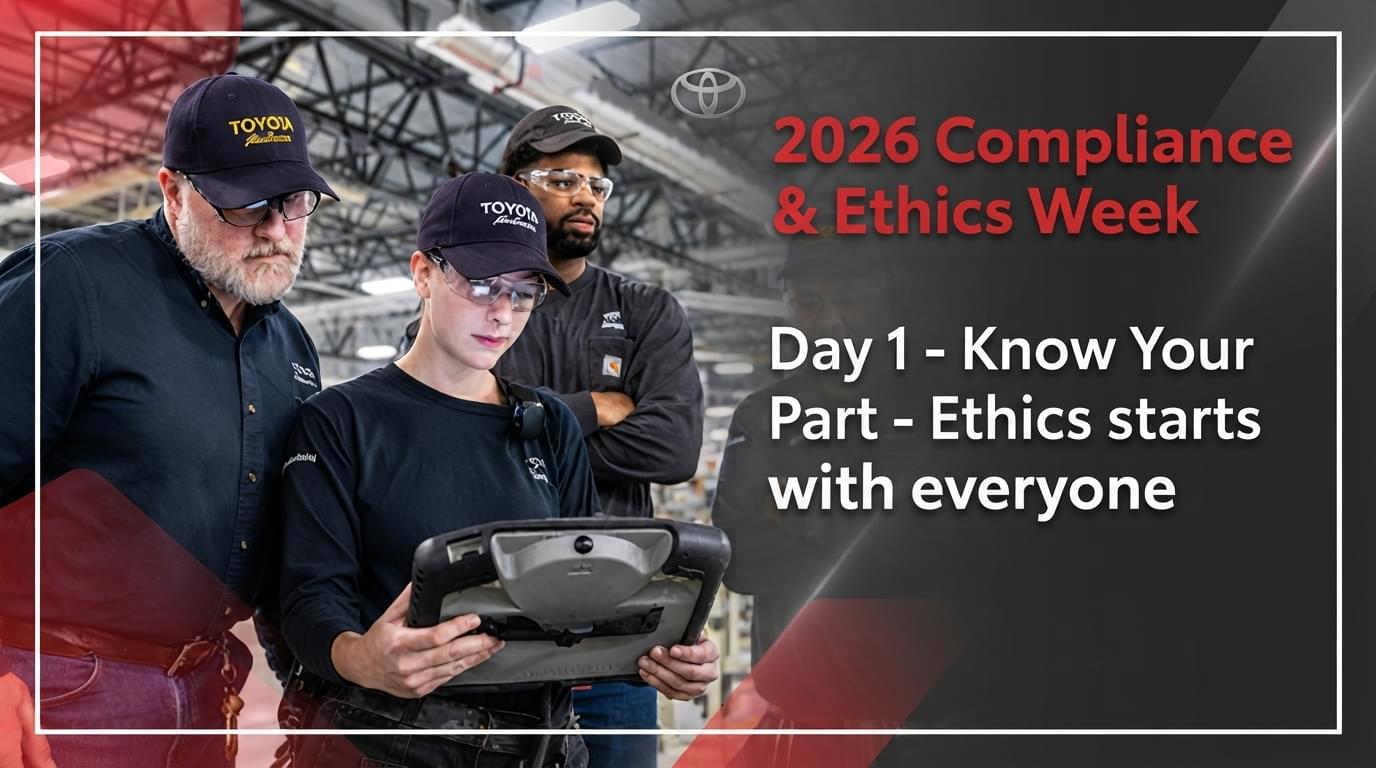
Day 1 - Know Your Part - Everyone contributes to Toyota's ethical culture.
At Toyota, we don't just build vehicles—we build trust. Every day, in every role, each of us plays a part in shaping the ethical culture that defines who we are. Whether you're in manufacturing, at a dealership support office, in a regional office, or working remotely, your choices matter. Ethics isn't reserved for executives or compliance teams. It starts with you.
Think about your typical workday. You review documents, send emails, have conversations with colleagues, make decisions about processes, and interact with suppliers or partners. In each of these moments, you have an opportunity to demonstrate integrity.
Your part might look like:
- Being honest when reporting data or results – even when the numbers aren’t what we hoped for
- Treating every team member with respect, regardless of their role or location
- Following established procedures, even when shortcuts seem tempting
- Asking questions when something doesn’t feel right
- Protecting confidential information – ours and our partners’
Toyota's reputation wasn't built overnight—it was built by people like you making the right choices, day after day. When we all know our part and play it well, we create a workplace where trust thrives, risks are caught early, and our customers can count on us. Small actions create ripple effects. Your integrity today shapes Toyota's tomorrow.

Day 2 – Be Alert - Ethics often starts by recognising when something doesn't seem right.
You've probably experienced it—that nagging feeling in your gut when something just doesn't add up. Maybe it's a request that seems unusual, a process being skipped, or a conversation that makes you pause. That instinct isn't random. It's your internal compass telling you to pay attention. At Toyota, we trust our team members to recognise these moments because ethical issues rarely announce themselves with flashing lights. They often start as small signals that something isn't quite right.
Every day, you encounter situations that require judgement. Most are routine. But sometimes, something feels different—and that feeling matters. Learning to notice and trust those signals is a critical skill.
Watch for moments like these:
- Someone asks you to “bend the rules just this once” or skip a standard procedure
- You’re asked to keep something from your supervisor or documentation
- A vendor or colleague offers something that feels like more than a normal business courtesy
- Numbers or reports don’t match what you’ve seen firsthand
- A deadline is pushing people to cut corners on quality or safety
The biggest problems often start small. A concern that's dismissed today can become a crisis tomorrow. When you are alert and take action—whether that's asking a question, pausing to verify, or raising a concern—you're protecting Toyota, your teammates, and our customers. Your awareness is one of our strongest defenses against risk.
Day 3 - Pause Before You Act - When in doubt, disclose early and ask questions.
In a fast-paced work environment, there's pressure to keep things moving. But when it comes to ethics, speed can be the enemy of good judgement. The best decisions aren't always the quickest ones—they're the ones made with full information and clear thinking.
"Pause Before You Act" isn't about slowing down productivity. It's about recognising that some moments require extra care. When something feels uncertain, whether it's a contract term, a gift offer, a data request, or a potential conflict, that's your signal to stop and think before proceeding.
Every day, you face decisions that may have ethical implications. Most are straightforward, but some require a closer look. Here's when to pause:
- You’re unsure if something is allowed – Don’t guess. If a policy isn’t clear to you, that’s a reason to ask, not assume.
- You feel pressure to skip a step – Rushing past normal processes is often a warning sign that something needs more attention.
- There’s a potential conflict of interest – Personal relationships, outside business activities, or financial interests that could influence your work should be disclosed early.
- Someone asks you to keep something quiet – Transparency is a core value. Requests for secrecy deserve scrutiny.
- You’re not sure who needs to know – When in doubt, disclose. It’s always better to share information proactively than to explain later why you didn’t.
Early disclosure protects you and the company. When you raise a question or flag a potential issue before it becomes a problem, you demonstrate integrity. You also give others the chance to help you make the right call.
Problems that seem small can grow quickly when left unaddressed. A minor conflict of interest can become a major compliance issue. An unclear policy can lead to unintentional violations. By pausing and asking questions early, you prevent small concerns from becoming big ones.

Day 4 - Speak Up - Early conversations prevent larger problems.
Most workplace issues don't start as crises—they start as small concerns that go unaddressed. A question left unasked. A conversation avoided. A gut feeling ignored. Over time, these small hesitations can grow into significant problems that affect people, quality, and trust.
Speaking up early isn't about creating conflict—it's about preventing it. When we raise concerns while they're still manageable, we protect ourselves, our fellow team members, and Toyota. The earlier we speak, the more options we have to resolve issues constructively.
Speaking up can feel uncomfortable, especially when you're unsure if your concern is "big enough" to mention. But here's the truth: if something is on your mind, it's worth a conversation.
You don't need to have all the answers or be certain something is wrong. You just need to start the dialogue. Ask a question. Share an observation. Flag what feels unclear. These early conversations often resolve issues before they escalate—and they always demonstrate good judgement.
Consider these moments when speaking up early matters:
- You notice a process being skipped or shortcuts being taken
- A colleague’s behaviour seems inconsistent with our values
- You’re being asked to do something that feels uncomfortable
- You overhear something that raises a concern
- You’re unsure whether a situation crosses an ethical line
Early conversations create a culture where honesty is normal—not exceptional. When people feel safe raising concerns, problems get solved faster, trust grows stronger, and our workplace becomes better for everyone.
Silence doesn't make problems disappear. It lets them grow. Your voice is one of the most powerful tools we have for protecting Toyota's integrity.
Day 5 - Make Ethics a Habit - The goal is not one week of activity but everyday behaviour.
This week, we've explored what it means to live our values every day. We've talked about knowing your part, being alert, pausing before you act, and speaking up early. But Compliance & Ethics Week isn't the finish line—it's a starting point.
Ethics isn't a one-time event or an annual training. It's a practice—something we build through small, consistent actions repeated over time. Just like any habit, ethical behaviour becomes second nature when we commit to it daily. The choices we make today shape the culture we experience tomorrow.
Making ethics a habit doesn't require grand gestures. It's about embedding integrity into the routine moments of your workday—the way you communicate, the decisions you make, the standards you uphold even when no one is watching.
Here's how to carry this week's lessons forward:
- Start each day with intention – Ask yourself: “How will I demonstrate integrity today?”
- Pause before you react – Give yourself a moment to consider the ethical dimension of decisions
- Keep the conversation going – Talk about ethics within your team, not just during CEW
- Use the resources – The Code of Conduct, Speak-Up Line, and Ethics Officer is available year-round
- Recognise others – Acknowledge colleagues who model ethical behaviour
Toyota's reputation isn't built in boardrooms—it's built on the production floor, in the office, in every interaction with customers and colleagues. Each of us plays a role in shaping that reputation through our daily choices.
When ethics becomes habitual, we don't have to think twice about doing the right thing. It becomes who we are, not just what we do. And that's how we build a culture of trust that lasts—not for one week, but for years to come.
